
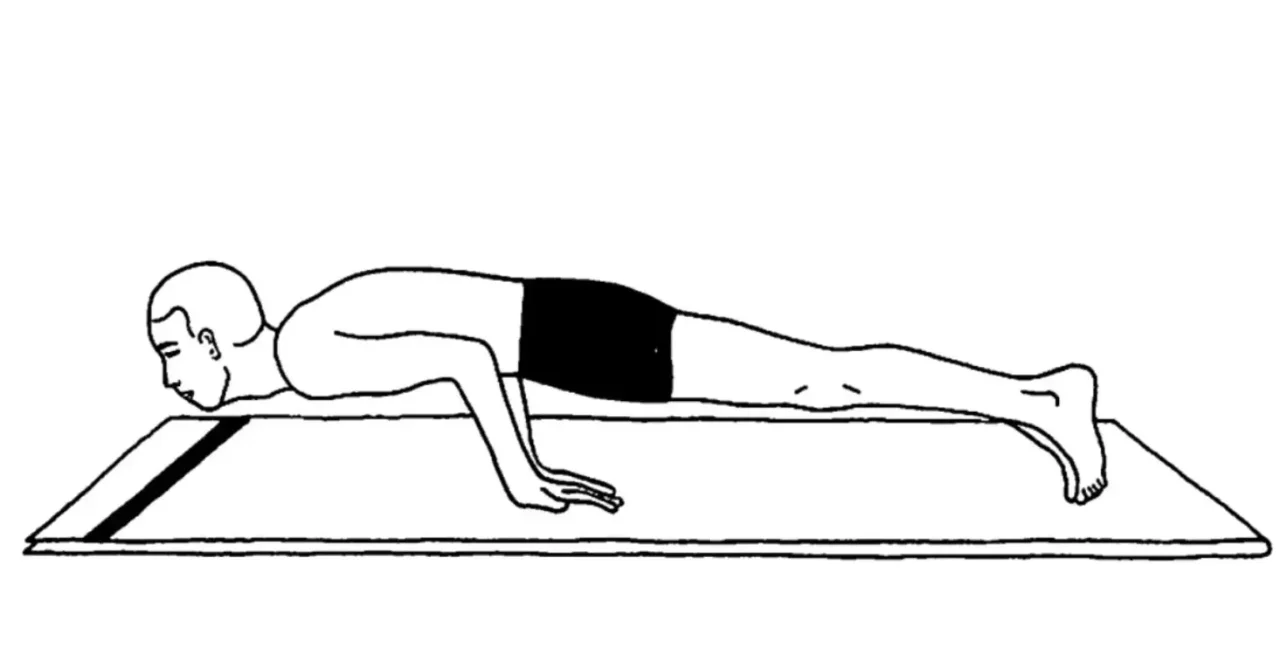
Hamsasana or Swan Pose is a common yoga pose which can be used to make the arms strong, enhance balance, and activate the abdominal organs. It is viewed as an antecedent pose of a more difficult Mayurasana (Peacock Pose). This pose demands concentration, good alignment, and controlled breathing and as such it is a significant practice to those students who aspire to gain stability and body awareness in yoga.
How to Practice Hamsasana (Step-by-Step)
- You may start with kneeling on the floor with your knees slightly apart and feet together.
- Keep your palms on the ground facing backward towards feet.
- Bring the forearms and the wrists in contact with each other.
- Lean gradually forward so that the abdomen is resting on top of the elbows and the chest is resting on top of the upper arms.
- Keep balance and slowly flex the legs backward till they straighten.
- Keep the feet clapped with the tips of the toes on the ground.
- Raise the head a little and make your eyes look at something fixed before you at the same level.
- In the last pose, the weight of the body must be taken on the hands and tips of toes.
- Be in the pose as long as it is comfortable without straining.
- To get out of the pose, get back to the floor slowly on the knees and sit in Vajrasana.
- Breath in and out, relaxing the whole body.
Breathing in Hamsasana
Breathing plays an important role in maintaining stability and comfort in this posture.
- Exhale completely before moving into the initial position.
- If holding the final position for a short duration, the breath may remain out briefly.
- If holding the posture longer, breathe slowly and deeply.
- Hold the breath out while lowering the body from the pose.
- Inhale gently after returning to the seated position.
Duration and Practice Rounds
The duration of Hamsasana depends on the practitioner’s level of experience.
- Advanced practitioners may hold the final position for up to 3 minutes.
- Beginners should start with a few seconds and gradually increase the duration over several weeks.
- The pose can be practiced for up to 3 rounds in one session.
Consistent and gradual practice helps build strength and confidence in balancing postures.
Awareness During the Swan Pose
While practicing Swan pose, awareness can be directed to different aspects of the body and energy system.
Physical Awareness
- Focus on the abdomen.
- Maintain balance and stability.
- Observe the flow of the breath.
Spiritual Awareness
- Concentrate on the Manipura Chakra, the energy center associated with strength and vitality..
Sequence and Role in Yoga Practice
Hamsasana is the preparation of Mayurasana (Peacock Pose) and may be done by those who perhaps lack the muscular strength needed to perform that posture. It is a good substitute that can still grow and gain equivalent prowess and dominance.
It should be noted however that such a pose must not precede turned upside down asanas in a yoga routine.
Contraindications
Certain individuals should avoid practicing Hamsasana. This includes people who have:
- Peptic or duodenal ulcers
- Hyperacidity
- Hernia
- High blood pressure
Pregnant women are strongly advised not to attempt this pose.
Benefits of Hamsasana
When mastered and followed regularly, Hamsasana has a number of physical advantages:
- Massages and rubs the abdominal organs.
- Makes the arms and the upper body stronger.
- Helps in supporting the muscles around the abdomen.
- Supports a good digestive system.
Learning Hamsasana in Yoga Teacher Training
During yoga teacher training in India, most students learn the principles of this asana, where traditional teaching methods place strong emphasis on proper alignment, breath control, and mindful awareness in every asana. In a structured 200 hour yoga teacher training in India, practitioners are guided progressively through preparatory poses like Hamsasana before advancing to more demanding arm balances such as Mayurasana. This systematic approach allows students to develop strength gradually while gaining a deeper understanding of technique, safety, and the foundational principles of yoga practice.
In recent years, learning has evolved beyond traditional face-to-face classrooms. Today, structured instruction on posture alignment, pranayama, and yoga philosophy can also be delivered through online yoga teacher training programs that provide guided virtual lessons and interactive study materials. While the experience may differ from a physical classroom, online yoga teacher training makes yoga education more accessible for students who cannot travel to a yoga school. At the same time, these programs maintain the quality, depth, and discipline of a traditional curriculum, allowing aspiring yoga teachers to learn authentic practices from experienced instructors from anywhere in the world.