I get some version of this question every week. Someone has narrowed it down to three or four schools, all with beautiful websites, all promising transformation, and they want to know how to actually decide. Fair question. Here’s what I’d actually tell a friend, not as a checklist against anyone else, just what I’ve learned matters after all these years of doing this.
Yoga that lives beyond the shapes
I’ve always said yoga starts in your mind, not on the mat. Look for a training that treats the practice as a tool for living, with philosophy and psychology woven right alongside the physical work. You’re not just learning to move your body well. You’re learning how your own mind is wired, and that’s the part that stays with you long after the postures become second nature.
A rhythm that lets you actually integrate
We’ve always run our yoga teacher training as weekend intensives, spread across many months rather than compressed into one stretch. Nine or so weekends, from spring into autumn. You learn something on a Sunday, then spend two or three weeks living with it, testing it in your own life, before the next module begins. That gap between weekends is where a lot of the real learning happens. It gives what you’ve absorbed time to settle into who you actually are, not just what you can perform in a room.
Teaching from early on
You cannot learn to lead a room from a lecture hall alone. At some point you have to stand up, cue a pose, give an adjustment, and feel a little awkward doing it in front of your peers. The sooner that starts, the sooner it becomes natural. Look for a training that gets you practicing early and often. Our own graduates consistently tell us it’s that early hands-on practice, more than any theory, that made them feel like real teachers by graduation.
A foundation in principles, not a script
We built our own approach around a simple idea we call Antastha, a Sanskrit word meaning “the deepest”: grow by knowing, learn by doing. It’s coaching-based rather than script-based. What you want is grounding in real Hatha principles, the logic behind why one posture leads into another, so you can build a class from scratch and, over time, find your own voice as a teacher rather than borrowing someone else’s.
Faculty who bridge two worlds
Look at who’s actually teaching. The richest trainings pair people who grew up inside the living Indian tradition with people trained in modern anatomy and movement science. Ours, for instance, brings together teachers rooted in decades of yogic lineage alongside a physical therapist who’s been treating bodies since the late 1970s. That combination is what lets a practice be spiritually grounded and structurally safe at the same time.
Yoga Alliance registration
If you plan to teach professionally, run retreats, or eventually get insured, your school should be a Registered Yoga School with Yoga Alliance. It’s the one credential that travels with you anywhere in the world, and it’s worth confirming before you commit.
Letting go of the flexibility myth
I still hear this all the time: “I’m not flexible enough to do a yoga teacher training.” Flexibility is something yoga gives you, not something you need to bring with you. We’ve always taken a non-dogmatic, secular approach, which really just means we don’t care what you believe or where you’re starting from. What matters is curiosity and a willingness to look at yourself honestly. Every body that walks through the door is a yoga body.
A community that continues after graduation
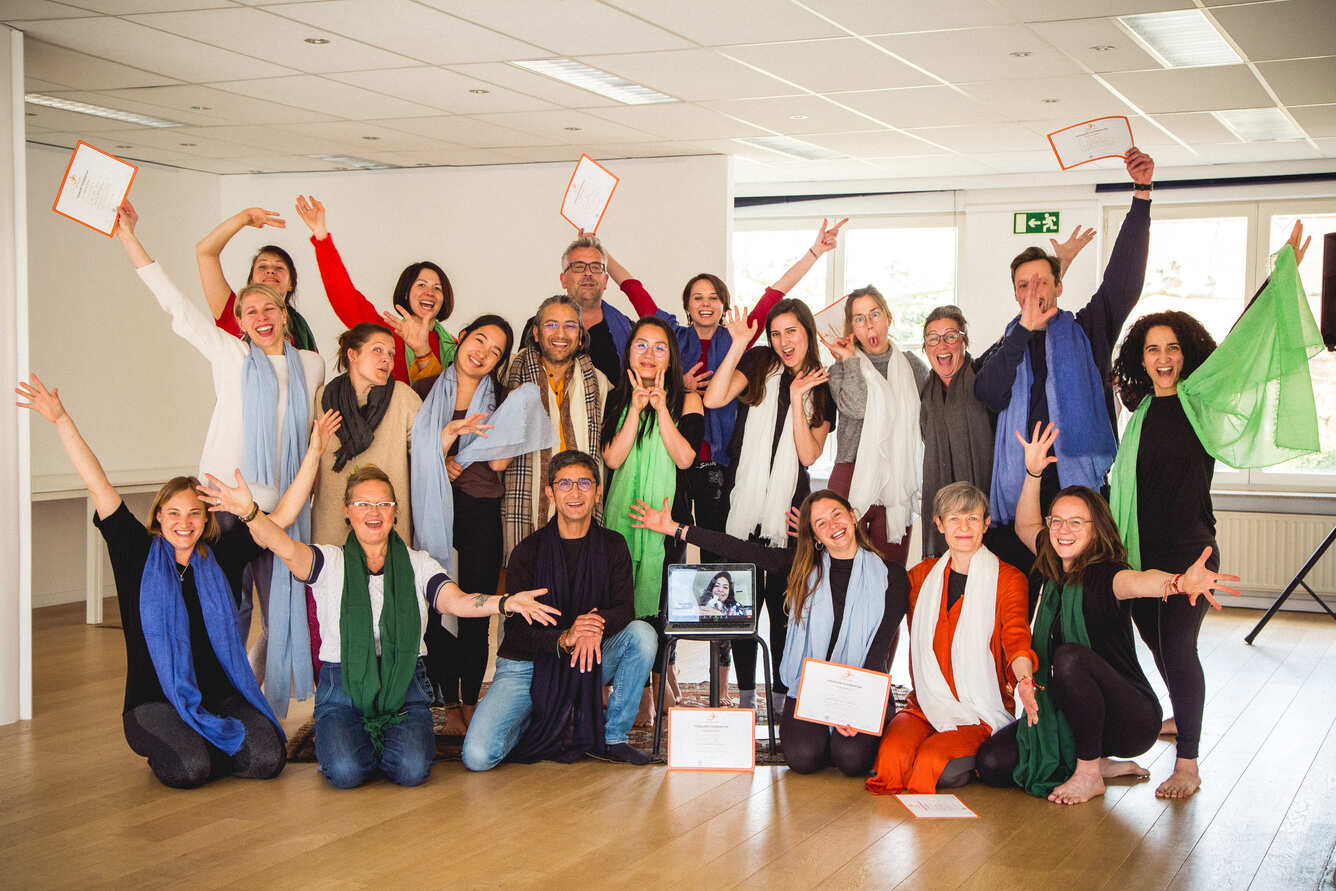
The real journey starts after you graduate, not before. A good number of our own teachers today started as students in our trainings and simply never left. Look for a school with that kind of living community, one that offers continuing education, somewhere you can return years later to refresh a skill or ask a question. A certificate should be the beginning of something, not the end of it.
Real, hands-on practice
The skill of physical, in-person adjustment is what lets you work safely with different bodies and real physical limitations, and it has to be practiced in the room, not just watched. We call ours Sahayog, our asana clinic, and it’s a non-negotiable part of our own curriculum. Look for something equivalent wherever you train.
A track record you can actually see
The best proof of a school is what its graduates go on to do. Over the years we’ve worked alongside the World Health Organization, the World Bank, UNHCR, and the Solar Impulse round-the-world flight project, and trained wellness leads inside companies like Nokia/Siemens and Telekom. A school with decades behind it and a graduate network doing real work in the world has already proven the method holds up far beyond the studio.
We started Yogalife in India in 1999, teaching yoga to prisoners at Tihar Jail in New Delhi alongside actors, artists, and athletes, long before it was anyone’s idea of a career. From there the journey went to Geneva, Brussels, Cologne, Luxembourg, and beyond, and today we’re a family spread across Switzerland, Germany, Belgium, Luxembourg, Spain, and India, with more than 1,800 graduates behind us.
Yoga starts in your mind. If any of this resonates, we’d love to have you join us. We run early bird pricing and payment plans throughout the year to make it as easy as possible to say yes.